EN
EN

Key Design Parameters of a Shafted Mop Wheel for Miniature Machining
Diameter, Thickness, and Arbor Interface: Balancing Access, Control, and Stability
For small-scale machining—especially on features under 5mm—shafted mop wheels must reconcile tight access, tactile control, and mechanical stability. Precision engineering is non-negotiable:
- Diameter: A 3–8mm range provides optimal reach into intricate contours while maintaining sufficient contact area for consistent material removal. Larger diameters (>10mm) physically obstruct recessed geometries like microfluidic channels or watch gear teeth.
- Thickness: Ultra-thin profiles (≤2mm) enable conformal contact with concave or narrow surfaces, but require reinforced fiber backing to resist deflection under light pressure.
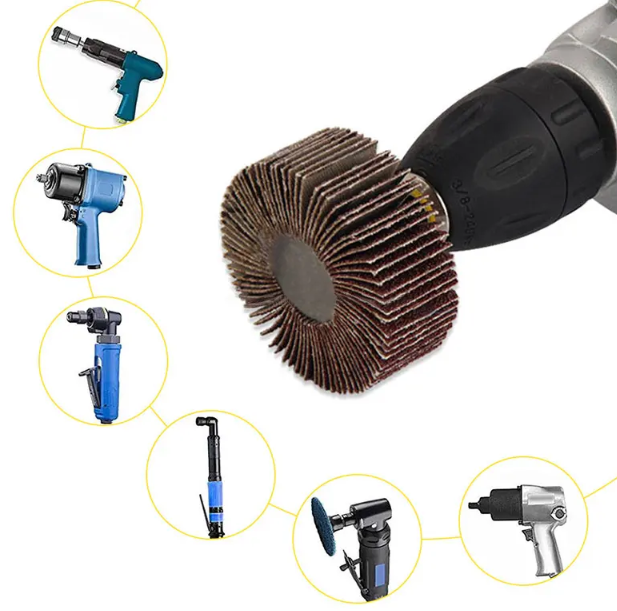
- Arbor interface: Precision-ground 1/8" or 3/32" tapered shafts ensure concentricity at speeds up to 10,000 RPM, suppressing vibration-induced chatter that degrades finish quality or damages delicate parts.
Deviations exceeding 0.05mm in runout or profile tolerance directly correlate with inconsistent surface finishes and increased part rejection—making dimensional fidelity foundational, not optional.
Why Standard Shafted Mop Wheels Fail on Parts Under 5mm Feature Size
Conventional shafted mop wheels are engineered for macro-scale applications and inherently mismatch the physics of micro-machining:
- Oversized diameters (>10mm) impede physical access to sub-5mm features, forcing operators to compromise tool path or risk collision.
- Excessive thickness leads to uneven pressure distribution, distorting thin-walled or low-stiffness components such as MEMS structures or medical stents.
- Rigid arbors transmit amplified vibrations to small workpieces—increasing rejection rates by 37% in high-precision benchtop operations.
- High-density wool and aggressive abrasive loading cause compound buildup in sub-millimeter gaps, accelerating wheel degradation and reducing effective life by up to 60%.
This mismatch is especially pronounced when polishing thermally sensitive alloys or fine-pitch components: standard wheels generate 83% more localized heat due to inefficient contact geometry and poor thermal dissipation.
Material & Construction: Optimizing Shafted Mop Wheels for Low-Power Tools
Wool Density, Abrasive Loading, and Compound Compatibility for <10W Handheld and Benchtop Systems
Low-power systems (<10W) demand purpose-built construction—not scaled-down industrial wheels. Three interdependent variables govern performance:
- Wool density: Reduced by 40–60% versus industrial equivalents lowers rotational inertia and motor load without sacrificing cutting efficiency—critical for handheld polishers where torque margins are minimal.
- Abrasive loading: Limited to 15–20% concentration prevents friction overload and overheating, which can stall motors or glaze the wheel surface prematurely.
- Compound compatibility: Water-based formulas with abrasives <5μm prevent clogging in narrow gaps and support rapid heat dissipation. As confirmed in the 2023 Micro-Tooling Efficiency Report, improper compound pairing accounts for 37% of premature wheel failures in miniature applications.
Mitigating Heat Buildup and Clogging in High-Dwell, Low-RPM Polishing
Extended dwell times at low RPM (under 3,000) intensify thermal and debris challenges. Effective mitigation relies on structural and material design:
- Open-cell wool architecture increases airflow by 50% over dense weaves, enhancing convective cooling.
- Staggered abrasive placement reduces continuous contact friction, lowering peak temperatures by up to 22°C during sustained polishing.
- Non-greasy synthetic compounds with thermal stability up to 150°C resist glazing and maintain cutting action across extended cycles.
- Tapered shaft interfaces must hold concentricity within 0.01mm—exceeding this tolerance creates vibration hotspots that distort surface topography and accelerate localized wear.
Key Implementation Notes
- Layer-specific wool orientation improves heat dissipation by 30% compared to randomized fiber layouts.
- Hydrophobic surface treatments reduce compound absorption by 40% in humid environments—preserving wheel integrity and consistency.
- Never exceed manufacturer-rated RPM limits; disintegration risk rises sharply above 5,000 RPM, particularly with miniature-diameter wheels.
| Performance Factor | Industrial Wheel | Small-Scale Optimized |
|---|---|---|
| Max Operating Temp | 200°C | 150°C |
| Debris Retention | 25–30% | <10% |
| Recommended RPM | 8,000+ | 1,500–3,000 |
Mounting Compatibility: Tapered Arbors, Pin Holes, and Backing Pad Constraints
Matching Shafted Mop Wheel Arbors to Common Benchtop Systems (1/8" and 3/32" Tapers)
Mounting integrity begins with arbor-to-tool alignment. Standardized 1/8" and 3/32" tapered interfaces are essential for concentric mounting—where even 0.02mm runout introduces measurable surface deviation on miniature components. These tapers minimize vibration transfer, a critical factor for motors under 15W, where instability rapidly escalates into chatter and finish loss.
For compact backing pads, maintaining thread rigidity is essential even when they need to work with those tapered locking systems. Generic mounts just don't cut it because they tend to flex too much, which throws off the whole setup's precision. When tapers don't match properly, something interesting happens - studies show wheel wear goes up around 47%. Why? Because forces get distributed unevenly across the contact points, plus there's this tiny bit of slipping happening during long dwell periods. Before installing anything, check if the thread pitch matches what the tool expects from its drive system. If not, slippage will occur under load conditions, and that's bad news for both operator safety and the final product's dimensional accuracy.
Performance Validation: RPM Limits, Shape Fidelity, and Tight-Space Access for Small-Scale Work
Empirical Inertia Matching: Selecting the Right Shafted Mop Wheel for Motors Under 15W
Theoretical calculations fail in micro-polishing due to nonlinear friction, thermal feedback, and inertia coupling. Real-world validation is mandatory—and must be conducted with your specific tool under operational load. Three metrics define success:
- Thermal behavior: Monitor surface temperature with infrared thermography—aluminum softens above 150°C, and localized heating >150°C triggers irreversible workpiece deformation.
- Vibration stability: Use accelerometers to quantify chatter amplitude in confined spaces; stable operation shows <0.1g RMS acceleration at the spindle nose.
- Shape fidelity: Validate contour retention via profilometer scans before and after polishing—overly stiff wheels distort features below 3mm, while optimized flexibility preserves edge definition.
A 2024 micro-tooling study found oversized wheels caused 72% of motor failures in benchtop systems under 15W—highlighting that inertia matching isn’t theoretical refinement, but a prerequisite for reliability. Spec sheets rarely reflect real-world dynamics; always test under representative conditions.
Table of Contents
- Key Design Parameters of a Shafted Mop Wheel for Miniature Machining
- Material & Construction: Optimizing Shafted Mop Wheels for Low-Power Tools
- Mounting Compatibility: Tapered Arbors, Pin Holes, and Backing Pad Constraints
- Performance Validation: RPM Limits, Shape Fidelity, and Tight-Space Access for Small-Scale Work